




What Is ESP in a Car? How This Safety Feature Keeps You on the Road
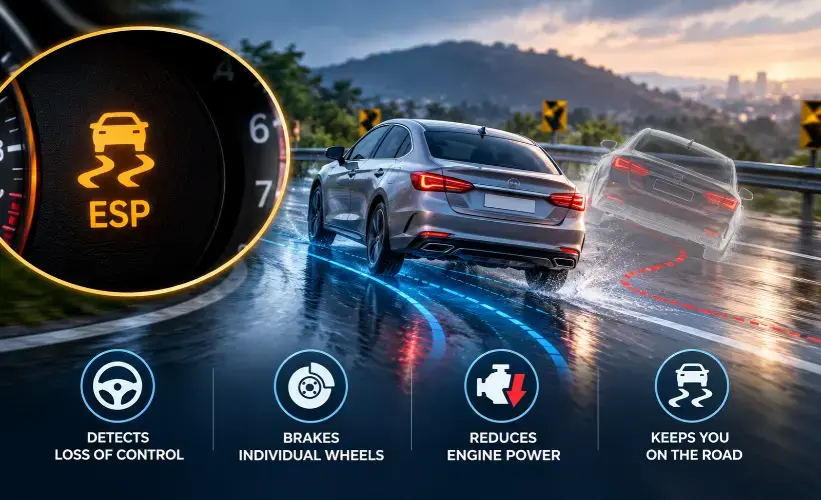
Picture this. It has rained for an hour, you take a curve on a highway a bit too quickly, and the rear of the car starts to step out. Your heart jumps. Then, without any drama, the car straightens itself and you carry on. Most drivers never realise that a feature called ESP just saved them from a skid. So, what is ESP in car terms, and why do safety experts keep pushing for it? Let's break it down in plain language.
Quick Answer
ESP stands for Electronic Stability Program. It is a safety system that detects when your car is starting to skid or slide and automatically brakes individual wheels and trims engine power to bring the car back on its intended path. You do not switch it on. It runs in the background every time you drive.
What is the Full Form of ESP in Cars?
The full form of ESP in cars is Electronic Stability Program. The name was used by Bosch, the German supplier that developed the system, and by Mercedes Benz, which launched it in the mid 1990s. The "P" means Program, but the function is identical to what other carmakers call Electronic Stability Control.
Here is how the same idea shows up under different names:
Brand or term | Name used |
|---|---|
Bosch, Mercedes, Maruti, Tata, Mahindra | ESP |
Toyota | VSC (Vehicle Stability Control) |
Honda | VSA (Vehicle Stability Assist) |
Hyundai and Kia | ESC or VSM |
BMW | DSC (Dynamic Stability Control) |
Ford | AdvanceTrac |
So if a brochure says ESC, VSC or DSC, it is the same kind of protection.
What is the ESP System in Car and How Does It Work?
Think of ESP as a very quick co-driver who watches your steering and the car's motion at the same time. It checks them many times every second.
The sensors behind ESP
ESP depends on a few key sensors:
Steering angle sensor: Reads where you want the car to go
Yaw rate sensor: Measures how much the car is rotating
Lateral acceleration sensor: Measures sideways force
Wheel speed sensors: Track the speed of every wheel (shared with ABS)
What happens in a skid
The control unit compares your steering input with the car's real movement. If the two do not match, ESP steps in.
Detects the difference between your intended path and the actual path.
Brakes one or more wheels individually, usually the outer front wheel in an oversteer skid or the inner rear wheel in an understeer slide.
Reduces engine power if needed.
Stops when control returns. Often you only notice a flashing light on the dashboard and a faint grinding or pulsing sound.
Oversteer and understeer in simple words
Understeer: You turn the wheel but the car pushes wide and refuses to turn. Front tyres lose grip.
Oversteer: The rear of the car swings out, and the car spins more than you want. Rear tyres lose grip.
ESP is designed to catch both.
What Is ESP in a Car Used For?
The main use is preventing loss of control. That includes:
Emergency lane changes to avoid an obstacle
Wet or oily roads
Sharp corners taken at speed
Gravel, sand or loose surfaces
Sudden swerving to avoid animals, which is a daily reality on Indian roads
It does not replace careful driving, but it gives you a safety margin when things go wrong in a split second.
How ESP Differs From ABS, EBD and BA
Many buyers see a long list of acronyms on a spec sheet and assume they are the same thing. They are not. They work as a team.
Feature | Full form | What it does |
|---|---|---|
ABS | Anti-lock Braking System | Stops wheels from locking during hard braking so you can steer |
EBD | Electronic Brakeforce Distribution | Sends the right amount of braking force to each wheel |
BA | Brake Assist | Recognises panic braking and applies full pressure faster |
TCS | Traction Control System | Stops wheelspin when you accelerate |
ESP | Electronic Stability Program | Prevents skids while cornering or swerving |
What is EBD and ESP in cars together?
ABS and EBD help you stop in a straight line. ESP helps you stay on your line while turning or swerving. ESP actually uses the ABS hardware, which is why you will rarely find ESP in a car that does not have ABS.
What is ESP and BA in cars?
Brake Assist is a helper for emergency braking. ESP is a helper for stability. In a real emergency, both can activate within the same second, one slowing the car quickly, the other keeping it pointed the right way.
Does ESP Really Make Cars Safer?
Yes, and the evidence is strong. The Insurance Institute for Highway Safety in the US has found that stability control cuts the risk of fatal single vehicle crashes by roughly half. Studies by NHTSA also point to a big reduction in rollover crashes, especially for SUVs. Because of this, ESC has been mandatory on new passenger cars in the US and the European Union for years.
India is moving in the same direction. Bharat NCAP gives weight to electronic stability control in its safety assessment, and a growing number of models now offer ESP as standard. Still, rules change, and ESP is often limited to higher variants. Always check the variant list before you buy.
Is ESP Worth Having in a New Car?
For most buyers, the answer is a clear yes. If you are asking "is ESP worth buying" on a mid range car, consider this:
The cost of stepping up to an ESP variant is small compared to the cost of a crash
You drive on mixed roads with potholes, water, animals and aggressive traffic
Families, long distance drivers and highway commuters benefit the most
If you drive mostly in slow city traffic, you will notice it less, but one bad moment is all it takes.
Pros and Cons of ESP
Pros
Reduces the chance of skids and rollovers
Works automatically, with no training needed
Helps in rain, on loose surfaces and in emergency swerves
Often improves insurance and resale appeal for variants that have it
Cons
Adds to the variant price
Can feel intrusive to enthusiasts who want to slide the car
Gives a false sense of security if you drive faster than conditions allow
Repairs to the hydraulic unit can be expensive
What Does the ESP Warning Light Mean?
The ESP light usually shows a car with wavy lines behind it.
Flashing while driving: ESP is working right now. This is normal. Ease off the throttle.
Solid light after you start the car: The system has detected a fault or has been switched off.
Solid light with the ABS light: There is likely an issue shared with the braking system.
Why is the ESP light on?
Common reasons include:
A dirty or faulty wheel speed sensor
A steering angle sensor that needs calibration, often after wheel alignment or battery replacement
Mismatched tyres or uneven tyre pressure
A faulty brake light switch
A weak battery
A fault in the ABS or ESP control module
If the light stays on, get it scanned at a trusted workshop. Driving is usually possible, but you have lost an important safety net.
What Is the ESP Off Button?
Many cars have an "ESP Off" button on the console. It is not for everyday use. It is useful when you are stuck in mud, sand or snow, where a little wheelspin helps you rock the car free. Switch it back on once you are moving again.
ESP Maintenance Tips
ESP does not need a service of its own, but a few habits keep it working well.
Keep all four tyres at the correct pressure
Replace tyres in sets or at least in pairs of the same type and wear level
Get wheel alignment done correctly, then check ESP calibration if the light appears
Keep the battery healthy
Scan fault codes early instead of waiting
Common Mistakes Drivers Make
Switching ESP off for "fun" on public roads
Thinking ESP means you can drive faster in the rain
Ignoring a solid warning light for months
Fitting mismatched or worn tyres, which confuses the sensors
Forgetting that ESP cannot create grip where none exists
Expert Tip
Treat ESP like a seatbelt for your steering. You hope you never need it, and you should never drive as if it will rescue you. If you ever feel the light flash and the pedal pulse, take it as a message: you were close to the limit. Slow down and reassess.
The Future of ESP
Modern cars are adding layers on top of ESP, such as torque vectoring, rollover mitigation and integration with ADAS features like lane keep assist and automatic emergency braking. Electric cars use the same logic but can react even faster, since motors respond almost instantly. Expect stability systems to become standard across most segments in the coming years.
Key Takeaways
ESP is the same technology that many brands call ESC (Electronic Stability Control).
It works using sensors that compare where you steer with where the car is actually going.
It can brake a single wheel, which no human driver can do.
ESP works together with ABS, EBD and Brake Assist.
A glowing ESP warning light can point to a minor sensor issue or a bigger fault, so do not ignore it.
It helps, but it cannot beat physics. Slow down in bad conditions.
Final Verdict
So, what is ESP in car design? ESP is one of the most essential safety equipment you can own and it doesn't require any notice, every day. If you are purchasing a new car, don't overlook noticing ESP in the options list along with ABS, EBD and airbags. The small cost of upgrading to it is well worth it.
Thinking of your next car? Discover more guides, how tos and buying tips on CarBike247 and make the most informed choice.
Frequently Aksed Questions (FAQs)
What is ESP in car in simple words?
It is an electronic safety system that stops your car from skidding by braking individual wheels and cutting engine power when needed.
What is the full form of ESP in cars?
Electronic Stability Program.
What is ESP in a Bosch version?
Bosch is the company behind the original ESP technology, and many carmakers use Bosch built systems or their own versions of it.
What is ESP and BA in cars?
ESP keeps the car stable, while Brake Assist applies full braking force faster during a panic stop.
Can I drive with the ESP light on?
Yes, in most cases, but the stability protection may be off. Get it checked soon.
Can I turn ESP off?
In most cars you can, using a button. Keep it on for normal driving.
Which is best, ESP or traction control?
They do different jobs. Traction control manages wheelspin, while ESP manages skids and stability. ESP is the more complete system, and most cars with ESP include traction control as well.
Does every car in India have ESP?
No. It depends on the model and variant, so check the spec sheet.
Jai Bhatt
Article Author