







What is RPM in a Car? A Simple Guide for Everyday Drivers
Quick Answer
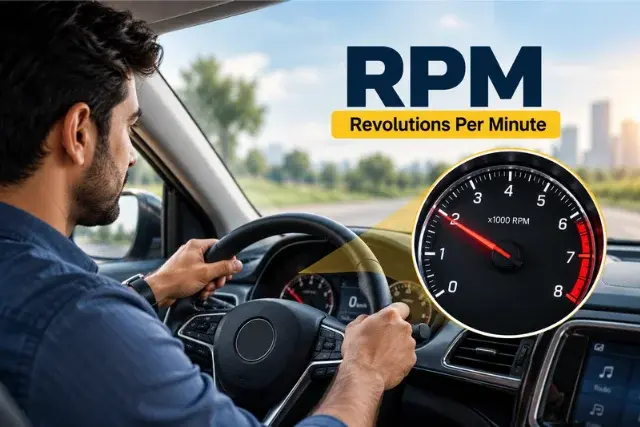
RPM is the number of revolutions of the crankshaft of an engine in one minute. It is often indicated on the tachometer found on the car's dashboard and is measured in thousands of RPM.
If you ask ten car owners about the function of the dial on the far left of the dashboard, at least five of them won't have a clue. They know what the speedometer is for, the other dial is just there, for the needle to go up and down. But what is RPM in a car, and should you care? Yes, you should!
What's the Full Form of RPM in a Car?
The acronym RPM stands for revolutions per minute. RPM refers to the rotation of the crankshaft by 360 degrees, which is basically once full revolution of the crankshaft. This is the essential component that changes the motion of the pistons into the rotation that powers your wheels.
Hopefully, that helps understand why you're seeing such an RPM.
How Does Engine RPM Actually Work?
Think of a cyclist. Pedalling faster means more leg turns every minute. An engine works the same way. Fuel and air burn inside the cylinders, push the pistons down, and the crankshaft spins. The faster this cycle repeats, the higher the RPM.
Your gearbox then decides how much of that spin reaches the wheels. In first gear, the engine spins a lot for every wheel turn. In sixth gear, it spins far less. That is why the engine sounds busy at 40 km/h in second gear and calm at 100 km/h in top gear.
What is an RPM Meter in a Car?
Have you ever thought about why there is a big round dial on the dash of your car? Well, that would be the RPM meter or a tacho meter, which is used to display engine speed. Even your digital speedometer shows it as a bar or an arc. Want to know how it works? Read on!
What is the use of an RPM meter in a car?
It helps you with four things:
Choosing the right time to shift gears in a manual car
Driving more efficiently
Spotting abnormal idle or stalling
Staying out of the red zone, where the engine is stressed
What is the Input for the RPM Meter?
Ever wondered how your car's speedometer just "knows" how fast you're going? When it comes to newer vehicles, the engine control computer, or ECU, takes the signal for the engine speed from the crankshaft position sensor and transmits it to the instrument cluster through the vehicle's intra-car network.
Older vehicles used ignition coil pulse signals or alternator signals instead, so if your speedometer stops working while the engine is still running, it's likely a bad sensor or cluster. Want to see what kind of sensors your car uses?
What is the Normal Idle RPM in a Car?
Idle RPM is the engine speed when the car is on but you are not touching the accelerator.
Engine type | Typical idle RPM (approximate) |
|---|---|
Petrol, warm engine | 700 to 900 |
Diesel, warm engine | 750 to 900 |
Cold start | Higher, often 1,000 to 1,500 for a short time |
These are general ranges. Your owner's manual gives the exact figure for your model. A cold engine idles higher on purpose, to warm up faster. It should settle down within a minute or two.
What is the Red Zone on an RPM Meter?
The red zone is the marked area near the top of the dial. It is the limit the manufacturer says the engine should not cross. Petrol engines often redline around 6,000 to 7,000 RPM, while diesels usually stop earlier, near 4,500 to 5,000 RPM. Most modern cars have a rev limiter that cuts fuel before real damage happens, but you should not lean on it daily.
What is BHP and RPM in Cars?
Have you ever looked at a car brochure and wondered what those numbers and letters mean? You pick it up and see "88 bhp @ 6,000 rpm" and "115 Nm @ 4,400 rpm". So, what do they actually mean? Let's figure it out.
BHP (brake horsepower) demonstrates the power of the engine. It tells us the speed at which the engine is capable of performing.
Torque (Nm) is the pulling power (twisting force) while the vehicle accelerates from zero.
RPM is the rotational speed at which power or torque in the engine reaches a maximum.
What is max power BHP at RPM in cars means the engine makes its highest power at that exact RPM. For the example above, you get peak power at 6,000 RPM, not at 2,000.
What is Torque and RPM in Cars?
Torque and RPM are linked through a simple formula. Power in kilowatts equals torque in Nm multiplied by RPM, divided by 9,549. That is why an engine can have strong torque at low RPM and still make its peak power much higher up the dial.
Diesel and turbo petrol engines usually deliver peak torque early, often below 2,500 RPM. That is why they feel punchy in city traffic. Small naturally aspirated petrol engines need to be revved harder to feel lively.
What is Power PS in Cars?
PS (Pferdestärke) – literally, the German version of metric horsepower (the standard used in the UK, which is about 1% different from bhp). PS is a little below bhp at approximately 0.986 hp, but that's only a small difference. (Some brands use PS rather than bhp; Korean and European brands tend to do this more often).
What is a Good RPM for Driving?
There is no single right answer, but these everyday ranges work for most cars.
Situation | Good RPM range (approximate) |
|---|---|
Petrol city driving | 1,500 to 2,500 |
Diesel city driving | 1,200 to 2,000 |
Petrol highway cruising | 2,000 to 3,000 |
Diesel highway cruising | 1,500 to 2,200 |
Overtaking | Higher, as needed |
Shift up when the engine starts to sound strained, not when it feels lazy. Shift down when the car begins to struggle or shudder. Your ears are a good guide.
How RPM Affects Mileage
RPM's are down in the lowest gear and low RPM's are normally associated with less fuel used per kilometer. But, engine pounding in a low gear? Waste of time! And don't lug it either. You don't want to slow the engine down too much, or over-rev the low gear engine under serious load as this will cause your engine to knock.
Keep your driving methods smooth and easy. Don't get on the power too hard and be sure to shift early-don't lug the engine. Use cruise control where you can and have you adopted these fuel-efficient techniques yet? Most drivers find mileage becomes noticeably better when they do.
What Happens If RPM Is Not Right?
A healthy engine holds a steady idle. If the needle misbehaves, your car is trying to tell you something.
Why is Engine RPM Fluctuating or Misfiring?
Common causes include:
Worn spark plugs or weak ignition coils
A dirty throttle body
A vacuum leak
A dirty mass airflow sensor
Clogged injectors or poor quality fuel
A weak battery or failing alternator
If the car also shakes or the check engine light comes on, get it scanned at a good workshop soon.
What is the Reason for RPM Increasing in My Car?
What makes your idle suddenly rise? Sure, a little bit of high idleing is a normal result of the compressor running or starting the engine on a cold day. But if your hot idle rises, you may be looking at a vacuum leak or a stuck idle control valve. Stuck clutch? Would your RPMs shoot up on a manual if the clutch was slipping?
What Happens If RPM Is Not Up to Date?
If your tacho is frozen, stuck at zero or lagging behind the engine sound, the problem is usually the sensor, wiring or the instrument cluster, not the engine itself. It is still worth fixing, because the same sensor often feeds the ECU.
Common Mistakes Drivers Make
Revving a cold engine hard right after starting
Staying in a high gear at very low speeds
Ignoring a rough idle for months
Treating the red zone as a target
Comparing RPM between different cars, since every engine has its own sweet spot
Expert Tips
Curious how well you really know your car? Notice where the engine is humming along smoothly and where it's getting busy. Look at your owner's manual to get the power band and torque band for RPM. If you have an automatic or CVT, watch out for that RPM's ego - as the gearbox is in charge here. And if that needle starts chasing itself, don't wait for a failure.
RPM in Electric Cars: A Quick Look at the Future
Ever wondered why EVs don't even have a tachometer even though their motors run way above the 10,000 RPM mark? Here's why: your car runs on just one gear ratio and that is all you need to keep the needle still. As hybrid and EV cars start to take off in India, you might start seeing a few more dashboards that lack tachometers. But you'll still need to understand the RPM!
Key Takeaways
Ever asked yourself: "Who really cares how many revolutions I do each second?" Well, we'll tell you, and here's the reason: RPM is revolutions per minute in the context of a car.
An average petrol car idles at about 700-900 RPM, and even diesel engines tend to sit in a similar range. But don't be fooled-more RPM doesn't equate to more power. And great to drive, it might seem, while specification sheets might feature BHP and torque alongside a designated RPM. But what's the story there?
Whenever you notice RPM needle jumps, hunting, or RPMs hanging up high while idling, it's typically a clear indicator of something requiring a bit of attention.
Final Verdict
Curious about what RPM in a car really stands for? Or maybe how fast your engine's turning? It's one of the most important measurements on your dashboard, and you should take the time to learn it so you can benefit from good mileage, a comfortable drive, and less unexpected stuff.
Want more easy car tips & buying tips? Read the newest guides on CarBike247 and ride with confidence!
FAQs
What is RPM in car or bike specs?
Curious about what RPM stands for in a car? Many people are! (Revolutions Per Minute) tells us at what engine speed we get a specific power or torque; commonly written as bhp @ rpm or Nm @ rpm.
What is rpm in a car?
Put simply, RPM is a measurement of how many times an engine's crankshaft completes a full rotation each minute. It's basically the rate at which your engine is beating.
How many rpm in a car at idle?
Wondering about idle RPM? Usually it's in the 700 to 900 region for a warm petrol or diesel motor. But for specifics you'll need to consult your handbook!
Is high rpm harmful to a car?
Well then, is it bad to have high RPM? Short surges are no problem. But maintaining that kind of RPMs in the red zone isn't good for engine life or your fuel economy.
What is the ideal RPM to change gears?
Here's the caveat: Just about every petrol car, in normal driving conditions, is happy to be at 2,500-3,000rpm. For Diesels, the optimal range is between 1,800-2,500rpm.
What is BHP and RPM in cars? Which is more important?
BHP means maximum power, torque is how much you can pull and RPM is where do they pull from. Keep torque low and low rpm for city driving.
Why does my RPM needle bounce when idling?
Did you notice your rpm needle fluctuating as your engine idled? More often than not this is caused by a dirty throttle body, bad spark plug, vacuum leak, or low battery. Which one is it for you?
Jai Bhatt
Article Author