











New PUC Rules 2026 Introduced: What New Car and Bike Owners Need to Know
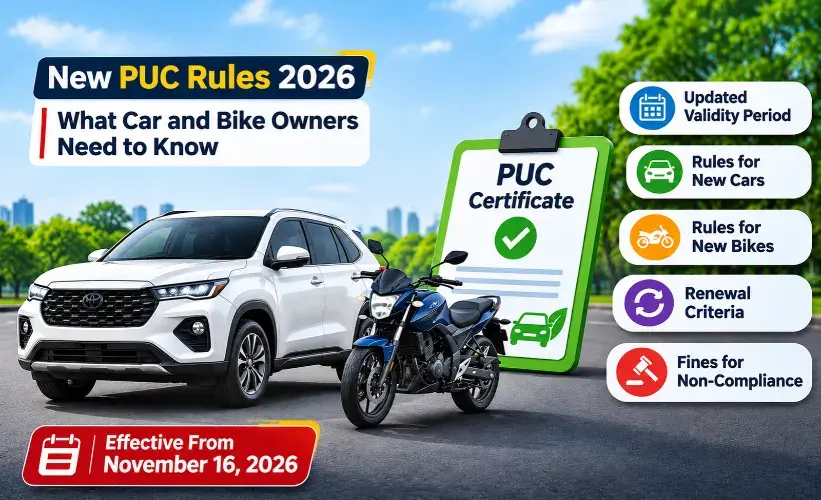
When you buy a new car or two-wheeler, you can heave a sigh of relief regarding maintenance, breakdowns and pollution checks. However, there is one more update that vehicle owners should remember. The Ministry of Road Transport and Highways (MoRTH) has introduced New PUC Rules in India, changing the validity period of Pollution Under Control (PUC) certificates for different types of vehicles.
As notified under the Central Motor Vehicles (Sixteenth Amendment) Rules, 2026, the new system links the duration for which a PUC can be issued to the emission standard for the Bharat Stage (BS) of a vehicle, the age of the vehicle, and the categorization for whether the vehicle is largely used or driven. For example, a new Bharat Stage 6 (BS6) car may not require renewal so often, while an older BS4 and BS3 vehicle would require frequent testing.
The New PUC Rules became operational on November 16, 2026, after publication in the Official Gazette. These changes are important for private car owners, two-wheeler riders and commercial vehicle operators who need to keep track of their PUC certificate expiry dates.
Here's a detailed explanation of the updated PUC rules for new car and bike owners, covering expiration period, renewal criteria and consequences.
What Are the New PUC Rules in India for 2026?
A Pollution Under Control (PUC) certificate confirms that a vehicle's emissions are within the prescribed limits under applicable pollution standards. It is issued after an authorised testing centre checks the vehicle's exhaust emissions.
Under the revised Rule 115 of the Central Motor Vehicles Rules, 1989, the certificate validity now varies according to the vehicle's emission category and age.
The major changes include:
Private BS6 vehicles up to six years old can have a PUC validity of three years.
BS6 transport vehicles up to six years old receive a validity of two years.
BS6 vehicles between six and ten years old require annual renewal.
BS6 vehicles older than ten years need renewal every six months.
BS4 vehicles require a fresh PUC certificate every six months.
BS1, BS2 and BS3 vehicles need renewal every three months.
The revised schedule reduces the testing frequency for newer BS6 vehicles while introducing shorter renewal cycles for older emission categories.
New PUC Certificate Validity Rules: Complete Breakdown
One of the most important aspects of the New PUC Rules is understanding how long a PUC certificate remains valid. The renewal period now depends on the vehicle's emission standard, age and whether it is registered as a transport or non-transport vehicle.
The following table summarises the revised validity periods under the 2026 amendment.
Vehicle emission category | Vehicle age | PUC certificate validity |
|---|---|---|
BS1, BS2 and BS3 | All ages | 3 months |
BS4 | All ages | 6 months |
BS6 non-transport vehicles | Up to 6 years | 3 years |
BS6 non-transport vehicles | Above 6 to 10 years | 1 year |
BS6 non-transport vehicles | Above 10 years | 6 months |
BS6 transport vehicles | Up to 6 years | 2 years |
BS6 transport vehicles | Above 6 to 10 years | 1 year |
BS6 transport vehicles | Above 10 years | 6 months |
Vehicle age is calculated from the date of first registration.
One important distinction is that private cars and personal two-wheelers generally fall under the non-transport category. Commercial vehicles, depending on their registration and use, fall under the transport category.
This distinction matters because a new private BS6 car and a new BS6 commercial vehicle have different PUC validity periods.
PUC Rules for New Car: How Long Is the Certificate Valid?
If you have recently purchased a new car, the revised rules bring some relief.
A private BS6-compliant car that is up to six years old can have a PUC certificate validity of three years. Earlier, BS6 vehicles generally followed an annual renewal cycle, regardless of their age.
This means owners of newer BS6 cars will not have to visit an authorised PUC testing centre every year.
For example, consider someone purchasing a new BS6-compliant petrol car in November 2026. Under the revised schedule, its PUC validity can extend to three years from the applicable first-registration date.
However, the longer validity does not mean that vehicle owners can ignore emission-related maintenance. A car should still be serviced regularly, and its pollution levels should remain within prescribed limits.
What about older BS4 cars?
The situation is different for BS4 vehicles. Their PUC certificate will now remain valid for six months instead of the earlier 12-month period under the national framework.
Therefore, owners of older petrol and diesel cars should check their emission category before assuming that their certificate is valid for another year.
PUC Rules for New Bike: What Two-Wheeler Owners Should Know
A Pollution Under Control (PUC) certificate is a document that indicates that the vehicle is emitting pollution within the specified limits specified by the pollution norms.
The validity of the certificate according to the new Rule 115 of the Central Motor Vehicles Rules, 1989 has become dependent on the age and category of the emissions.
The major changes include:
A private BS6 vehicle up to six years old can be issued a PUC with validity of three years.
6-year validity for buses and other transit vehicles. 6+ Years old transport vehicles will be valid for 2 years.
BS6 that are from six to ten years old, will be renewed annually.
BS6 vehicles older than ten years need renewal every six months.
For BS4 vehicles, you need a new PUC certificate every six months.
BS1, BS2 and BS3 vehicles require three-month renewal.
The amended schedule cuts testing frequency for newer BS6 vehicles and has shorter renewal cycles for old emissions categories.
Why Have the PUC Rules Been Changed?
The primary purpose of the new PUC system is to ensure that pollution tests are relevant to the age and emission standard of the vehicle.
Previously newer BS6 vehicles and much older BS6 vehicles had a fairly similar pattern of test and renewal every year. The new scheme takes into consideration that a certain class of vehicles with specific emissions standards and age profile may need to be tested less frequently.
The changes serve two purposes.
1. Testing less often for newer cars
The certificate duration for vehicles that have newer BS6 vehicles is longer because they meet higher emission standards. This means less trips to PUC testing centres for owners of relatively newer vehicles.
2. Increased oversight for older cars
Vehicles with older BS4 and BS1, BS2 and BS3 technology have shorter certificate of validation periods. This requires the emissions of these vehicles to be tested more often to ensure they stay within the limits.
In general, the new system seeks to accommodate the needs of newer car owners while still monitoring older vehicles for pollution.
What Happens to Existing PUC Certificates?
This is such a crucial detail that motorists should not miss out on. The new rules do not, by default, be declared invalid and expire at the time of their commencement.
As per the transitional clause in the amendment, certificates issued prior to November 16, 2026 will adhere to the new validity calendar only upon their first renewal subsequent to the new rules being applied.
Let's say that your BS4 car has a PUC valid up to March 2027.
You are not required to replace that certificate due to the amendment. If, when renewing it after expiration, you renew the new certificate will be under the six-month period.
This provision provides time for current certificate holders to transition to the new renewal cycle without their current certificates becoming invalid.
What Is the New Rule for PUC Certificate Renewal?
An additional significant clarification introduced by the amendment is whether, when is a renewed certificate deemed to be put into effect.
Renewal timings may impact the start of validity.
Here is the scoop:
Renewed PUC certificate within 10 days: PUC certificate renewed in the 10 days right before it expired will come into force from the previous certificate's expiry date.
Renewal after expiry: If the renewal is due after the existing certificate has expired, the new certificate takes effect from the actual date of renewal.
Example: Let's say your existing certificate has an expiry date of December 20. If you get a new one between December 10 and December 20, the new date is from December 20. But if you renew on 23, the new certificate takes place from December 23.
Thus, why it's necessary to check the expiry date beforehand. If you wait until the certificate actually expires, then you may leave a vacant window for PUC.
What Is the Fine for Driving Without a Valid PUC Certificate?
It is a punishable offence if the vehicle does not have a valid PUC.
The first offence will attract a fine of up to ₹10,000, up to three months' of imprisonment, or both, for contravention of prescribed air-pollution standards under Section 190(2). A second or subsequent offence will punish a person with an imprisonment of up to six months or a fine of up to ₹10,000, or both.
The procedure for challans and enforcement may vary based on the specific legal provisions in place and regional enforcement.
Car and bike owners should not think that an old vehicle or two-wheelers are necessarily taxed on the basis of a valid PUC in the new system.
An easy way to prevent unnecessary legal worries is to keep the certificate current.
Do the New PUC Rules Apply Across All Indian States?
Yes. An amendment to the Central Motor Vehicles Rules, 1989 has been introduced to include the revised validity schedule for SSCOC, which will be valid across the country.
But the laws and implementation of motor vehicle laws are under the state and Union Territory administration.
Hence, vehicle owners need to contact the respective state transport department or authorised PUC centre for local process, testing fee as well as for services related to PUC certificate.
You shall comply with the revised central validity schedule according to category of vehicle. For instance, whether you are driving in Delhi, Mumbai, Rajasthan, Gujarat or Karnataka.
State additional valid dates and local procedures to obtain/renew certificate, but does not create a separate schedule of validity dates.
How to Check Your Vehicle's PUC Validity
No, you don't need to wait for a police check to see if your pollution check has expired.
PUC details You may verify the PUC details on the official portal of Parivahan.
Steps to take:
Visit the official Parivahan website.
Look for the PUC Certificate section.
Check the options to view your PUC certificate.
Provide your reg no and details asked.
View the certificate status and validity information.
You may verify the date of issue and expiration of your printed or digital PUC certificate.
It can be helpful to save a digital copy so that you can refer to it when needed.
What Should Vehicle Owners Do After the New PUC Rules?
The new system is not asking every driver to go to the testing station immediately. Correct way is, give a quick look on emission standard, registration date and the validity of the current certificate.
Here are a few things worth doing:
Verify if your vehicle ( two-wheeler/ four wheeler) is BS4/ BS6 compliant.
Check if your vehicle is a transport or a non transport.
By the first registration date decide the age category.
Check the validity of the PUC certificate you have.
Renew the certificate within the prescribed time.
Save your most recent copy of the certificate to your computer.
These handful of tests can help you stay compliant and avoid trips to a test centre.
Frequently Asked Questions (FAQs)
1. What is the new PUC rule for cars in India 2026?
According to the new specifications, BS6 private vehicles aged 0-6 years can have their PUC validity extended to three years. BS6 private vehicles aged between 7-10 years and those aged more than 10 years can have their PUCs renewed on an annual and six-monthly basis, respectively.
BS4 private vehicles can have the PUC renewed on a semi-annual basis, while BS1, BS2 and BS3 private vehicles can get their PUCs renewed on a quarterly basis.
2. How often does a BS6 car require a PUC?
No. In the new time table, the PUC is valid for three years instead of one for a non-transport car upto six years old.
3. What is PUC for a new bike?
If you have a private BS6 motorcycle or scooter for up to six years, you need to check whether you have an active PUC certificate for three years. This can be renewed for every three years.
4. Does the new rule about PUC certificates apply for BS4 vehicles?
Yes. The validity of a PUC certificate for all BS4 (new or old) transport and non-transport vehicles is six months.
5. What are the new PUC rules for old vehicles?
BS1, BS2 and BS3 vehicles require PUC renewal every three months. BS4 vehicles require renewal every six months. BS6 vehicles older than ten years also need renewal every six months.
6. Are the new PUC rules applicable to current certificates?
The validity remains in force for existing certificates issued prior to 16 November 2026. The new schedule will take effect when they are renewed for the first time following the effective date of the amendment.
7. For a new BS6 commercial vehicle, what will be the validity of the PUC certificate?
A BS6 transport vehicle up to six years old has a PUC validity of two years. Vehicles above six and up to ten years require annual renewal, while those older than ten years require renewal every six months.
8. What if I renew the PUC certificate after expiry?
If you renew your certificate after it has expired, the certificate will become valid on the date of renewal, not the date the original certificate expired.
9. Has a fine of ₹10,000 for PUC certificate expired?
Section 190(2) of the Motor Vehicles Act can attract a fine of up to ₹ 10,000, imprisonment for up to three months, or both. The magnitude of the enforcement action can vary depending on the situation and the specific legal provisions.
Jai Bhatt
Article Author